top of page

THE GRAHAS: PLANETS IN VEDIC ASTROLOGY

If you do not have a copy of your Vedic Birth Chart you can calculate it here.

The nine grahas (graha literally means "that which seizes") function as archetypal forces operating through consciousness. Vedic astrology treats the grahas as agents of karma. Each carrying specific significations, governing particular life domains, and acting as natural indicators (karakas) for those domains regardless of chart placement.

The seven visible grahas (Sun through Saturn) plus the lunar nodes (Rahu and Ketu) form the traditional Jyotish system. Understanding planetary nature, strength, and relationship patterns provides the foundation for chart interpretation.

​​

SURYA | THE SUN
King of the Grahas | Element: Fire

The atman (soul), consciousness itself. Represents father, authority figures, government, leadership capacity, vitality, intelligence, and creative self-expression. Rules bones, heart, right eye. Karaka for father, authority, and the soul's essential nature.

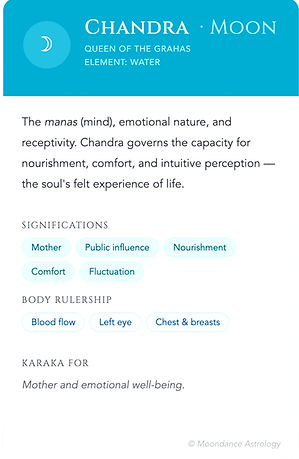
CHANDRA | THE MOON
Queen of the Grahas | Element: Water

The manas (mind), emotional nature, and receptivity. Represents mother, public influence, fluctuation, nourishment, comfort, and the capacity for intuitive perception. Rules blood flow, left eye, chest and breasts. Karaka for mother and emotional well-being.

MANGALA | MARS
Commander in Chief | Element: Fire

Courage, action, and directed force. Represents siblings, property, athletic capacity, weapons, military/police, surgery, immunity, and the capacity to fight for what one desires. Rules marrow, red blood cells, immunity. Karaka for siblings, courage, and property.

BUDHA | MERCURY
The Prince | Element: Earth

Intelligence, discrimination, and communication. Represents education, business acumen, writing, speech, mathematical ability, commerce, and analytical capacity. Rules skin, nervous system, speech organs. Karaka for intellectual capacity and commerce. (Secondary karaka for career in some contexts.)

GURU | JUPITER
The Advisor | Element: Ether

Expansion, dharma, and wisdom. Represents spiritual teachers, higher learning, children, wealth, optimism, philosophical understanding, and grace. Rules fat tissue and liver. Karaka for children, husband (in women's charts traditional relationships), wealth, and spiritual inclination.

SHUKRA | VENUS
The Minister | Element: Water

Beauty, pleasure, and relationships. Represents spouse, artistic capacity, luxury, fertility, romance, diplomacy, and sensual refinement. Rules reproductive fluids. Karaka for wife (in men's charts traditional relationships), marriage, and artistic expression.

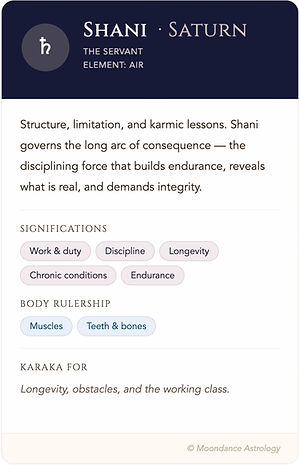
SHANI | SATURN
The Servant | Element: Air

Structure, limitation, and karmic lessons. Represents work, duty, discipline, poverty, longevity, chronic conditions, labor, and the capacity to endure hardship. Rules muscles. Karaka for longevity, obstacles, and the working class.

RAHU | NORTH NODE
The Shadow Planet | Element: Air

Obsession, foreign influence, and worldly ambition. Represents unconventional paths, technology, outsider status, sudden events, materialism, and the hunger for experience. Creates confusion and intense desire for the things it touches. Associated with poisons, deception, and innovation.

KETU | SOUTH NODE
The Shadow Planet | Element: Fire

Detachment, spirituality, and past-life tendencies. Represents moksha (liberation), occult knowledge, sudden loss, psychic sensitivity, and renunciation. Creates disinterest in worldly domains, spiritual seeking, and karmic completion. Associated with enlightenment and dissolution.

THE OUTER PLANETS

Traditional Jyotish does not incorporate Uranus (discovered 1781), Neptune (1846), or Pluto (1930), as these planets move too slowly to be observed within a human lifespan using ancient methods. However, their generational influence and transits to key chart points can correlate with significant collective and personal shifts.

  • Uranus carries themes of sudden awakening, technological innovation, electricity, revolution, and unexpected disruption.

  • Neptune governs inspiration, dissolution of boundaries, psychic receptivity, dreams, illusion, and collective spiritual movements.

  • Pluto represents psychological transformation, death and rebirth, shadow work, power dynamics, and profound regeneration.


These planets function primarily as generational markers and occasional transit triggers rather than as karakas or primary chart significators within the Vedic system.

While not part of classical Jyotish, I incorporate the outer planets when their transits or natal positions provide meaningful context—particularly for psychological depth work, generational patterns, and transformational timing. Their influence operates on a different timescale than the traditional grahas, but can illuminate certain archetypal dynamics that resonate with contemporary experience.

bottom of page